Insights
What to Know About Pro Audio Engineering for Events
Eight things to check before you hire an audio vendor for a corporate event, from the speaker plan and the engineer on your date to RF coordination and the stream feed.
Eight things to check before you hire an audio vendor for a corporate event, from the speaker plan and the engineer on your date to RF coordination and the stream feed.
Audio is the part of a show nobody compliments and everybody notices. Eight things to check before you put an audio vendor on your date, from the coverage plan down to who owns handing off the spare mic in a pinch.
Every room fights you differently. A hotel ballroom is drywall, glass, and a hard ceiling, so it throws energy straight back at the tables. A convention hall puts the last row 200 feet out and the sound still has to be intelligible when it arrives.
Ask how a vendor gets from an empty floor plan to a speaker plan. Room modeling and coverage mapping should come before anybody names a box.
Gear quality shows up in the last three rows. A K2 or Kara II hang holds level and tone from front fill to back wall in a way point source boxes will not in a big room.
Ask what a vendor keeps in regular service rotation, who maintains it, and whether the crew on your date works that same system every week. The crew that runs it every week gets more out of it than a crew seeing it fresh.
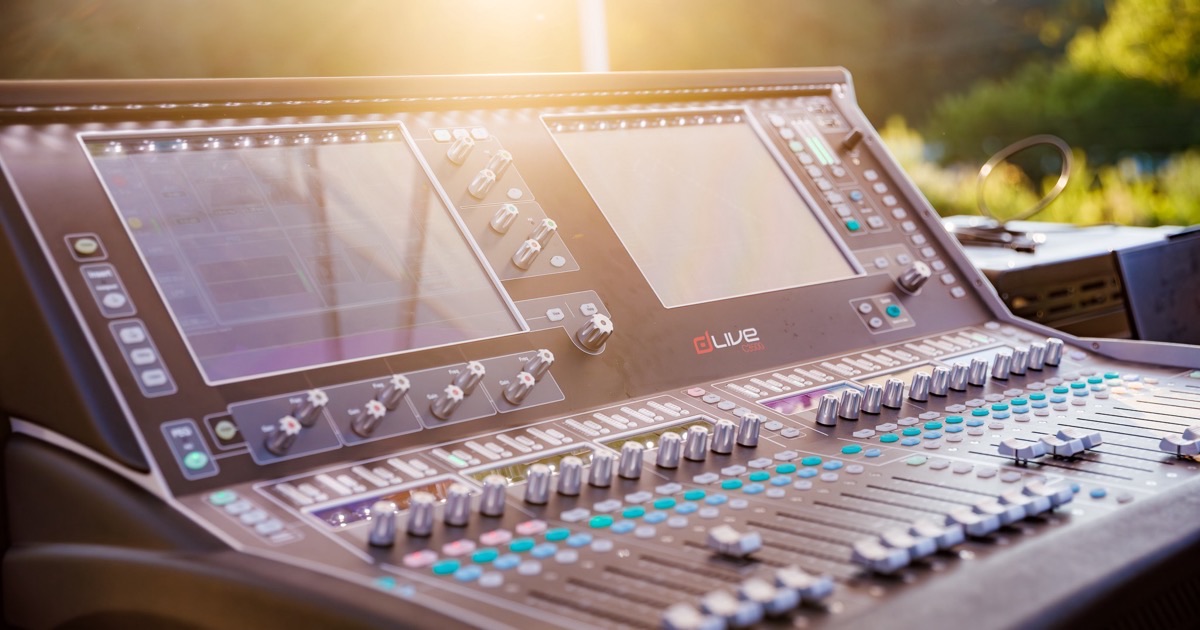
Equipment does not mix a show. The person at front of house decides whether your CEO reads clearly at the back of a 1,200 seat ballroom, and whether the band after dinner sounds like a band.
Ask who is on your date. Not the logo, the name. Ask what else they mixed that month, and whether they have run a general session and a live set in the same day.
Modern rigs lean on DSP for EQ, dynamics, and feedback control, and it keeps adjusting as the room changes through the day. That is not a substitute for a good speaker plan. It is what holds the plan together once 900 people walk in.
For multi-room conferences, ask what the audio rides on. Networked protocols like Dante and AVB carry it over standard Cat6 instead of a copper snake to every ballroom, so a tech at one rack sees levels across four rooms and fixes a problem in a breakout without leaving the general session.
Wireless mics and in-ear packs all run on radio frequency, and inside a hotel that spectrum can be crowded. A convention floor carries dozens of live devices, plus the house system, plus whatever the exhibitor two aisles over plugged in without telling anybody.
Your audio partner should scan the building, coordinate frequencies before doors, and continue watching the receivers all day. Proper RF management is invisible when it works. You learn it was skipped when a lav goes quiet mid keynote.
Agency shows change shape by the day. General session Tuesday morning, four breakouts Tuesday afternoon, awards dinner Wednesday, strike at midnight.
You want one technical director who owns load-in, the daily changeovers, the room flips, and strike, and who can tell you at 6am which room gets which package.
Live has no second take. Yes, redundancy is boring, and it is most of what you are buying: a spare handheld charged and on the wing, a backup frequency already coordinated, a processor in the rack ready to swap, and an engineer who knows the swap by feel.
Ask what happens when a console loses power thirty minutes into a keynote. A good answer is specific, and it has been rehearsed. Redundant power supplies and a UPS on the console are the difference between a half-second nobody hears and a keynote speaker standing on the stage in silence.
Broadcast needs a clean feed off the console with its own gain structure, no room mics bleeding into it, and latency handled so the remote audience is not clapping a second behind everyone else.
Ask who owns that feed on show day. If the answer is the video vendor and the audio vendor pointing at each other, fix it in the planning call, not at 8am on load-in.
It comes down to whether the system is designed for your room, whether the crew has run this exact kind of day before, and whether the schedule has a single owner.
Start early. A vendor worth having will want a site visit, your tech rider, and a look at the room before quoting anything.
We build and run audio systems for events across the Atlanta metro and the wider Southeast, and we go past that for the right job. From a boardroom of twelve to a festival field, with the engineers who run the rig. If you have a date on the calendar, get in touch and we will look at the room with you.
Line arrays, digital consoles, and professional wireless systems. Ask what the maintenance cycle looks like and when the system was last serviced.
Four to six months. That leaves room for a site survey, a real speaker plan, and coordination with the video and lighting vendors before anybody prices it.
A PA is boxes on sticks. Engineering is the acoustic read, the speaker plan, the tuning, the RF coordination, and somebody mixing the room live while it changes underneath them.
Speaker placement first, processing second. You aim energy at people and away from glass, then use DSP and delay to clean up what the room still gives back.
Ask who is on your date. Then ask about maintenance, failover protocol, and references from a show that looked like yours.
Yes, with the crew depth to do it. Ask how many technical directors they can put in the field that week and who coordinates between sites.
<em>Equipment</em> does not mix a show. The person at front of house does.Josh Bell / True Productions